

Panel: The Global Regulatory Landscape for Digital Assets
Navigating the Future Digital Finance Landscape 2026
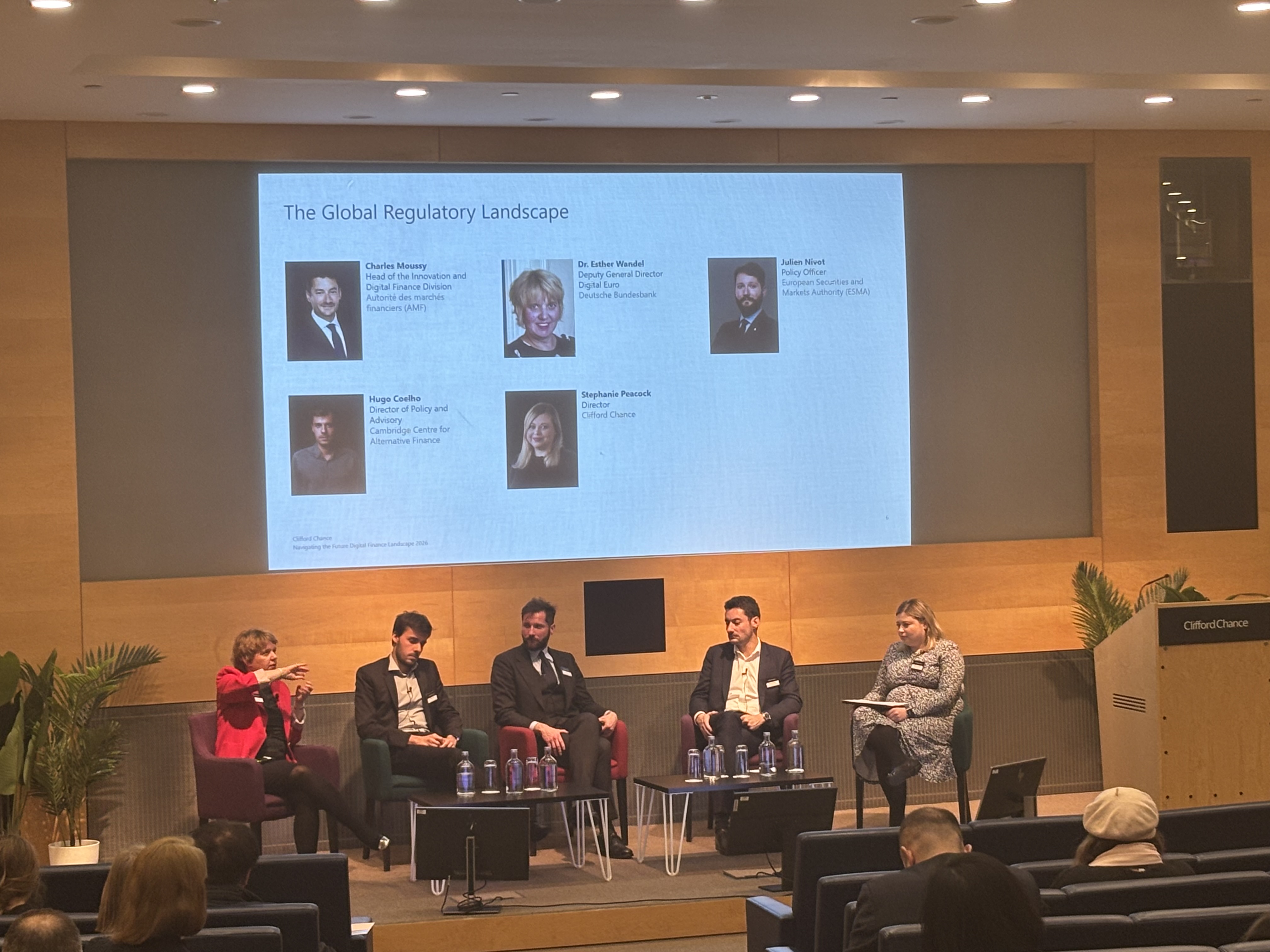
We were honoured to host a distinguished line up of European regulators, central bankers and global policy experts to examine how digital asset regulation is evolving across jurisdictions, alongside the impact of tokenisation and digital money, as part of our recent Navigating the Future Digital Finance Landscape event jointly hosted with the Global Blockchain Business Council (GBBC).
Speakers:
- Charles Moussy, Head of the Innovation and Digital Finance Division, Autorité des marchés financiers (AMF)
- Dr. Esther Wandel, Deputy General Director, Digital Euro, Deutsche Bundesbank
- Julien Nivot, Policy Officer, European Securities and Markets Authority (ESMA)
- Hugo Coelho, Director of Policy and Advisory, Cambridge Centre for Alternative Finance
- Stephanie Peacock, Director, Clifford Chance.
Panel Discussion
The panel opened with reflections on the EU’s early experience implementing the Markets in Crypto-assets Regulation (MiCA), which started taking effect in late 2024. We heard that the primary challenge is no longer drafting rules but ensuring supervisory convergence across Member States, particularly as transitional periods and national regimes overlap until mid‑2026. Fragmentation, divergent supervisory practices and complex group structures were flagged as areas of regulatory friction, alongside the need for consistent treatment of issues like ICT outsourcing and the integration of DeFi services into MiCA‑regulated models.
Turning to tokenisation, the speakers described genuine momentum across Europe, from tokenised MMFs and DLT‑based market‑infrastructure initiatives. They recognised that the EU’s current pilot regime is too narrow and needs expanded thresholds and flexibility to scale, and so welcome the EU's plans to significantly expand its scope as part of the Market Integration Package. Legal clarity across the full asset lifecycle, interoperable infrastructure and an effective “cash leg” - whether via stablecoins, tokenised deposits or a wholesale CBDC - remain critical for broader adoption. In parallel, emerging markets are experimenting at speed, often ahead of advanced economies, because they can build without the constraints of legacy systems.
The panel closed with a deep dive into digital money. Panellists agreed that stablecoins, CBDCs and tokenised deposits will each play distinct roles in the future financial ecosystem, with regulatory design choices shaping where they gain traction. On the retail side, the digital euro aims to address structural challenges in Europe’s payment landscape, including cross‑border fragmentation and reliance on non‑EU providers for cross-border payments. In parallel, wholesale CBDC is being prioritised to enable DLT settlement. Watch this space for developments around the Eurosystem's Pontes initiative, a major pilot planned to launch by the end of Q3 2026, building a bridge between DLT assets and traditional settlement rails. This sits alongside the longer-term project Appia, aiming to develop a secure, integrated financial infrastructure for Europe using distributed ledger technology (DLT) and tokenised assets.
The overarching conclusion was clear: global regulatory alignment is unlikely in the short term, but a shared focus on standards, interoperability and coordinated supervision will be central to the next phase of digital asset regulation.
Related content:
Explore more of the sessions from out event:
- Fireside Chat with Val Smith, UK Financial Conduct Authority
- Panel: The Vision the UK needs
- Fireside Chat with U.S. SEC Commissioner Hester Peirce
- Panel: Stablecoins and Tokenised Deposits: What is the ecosystem going to look like?
- Panel: TradFi Meets Crypto: Convergence or Coexistence?