
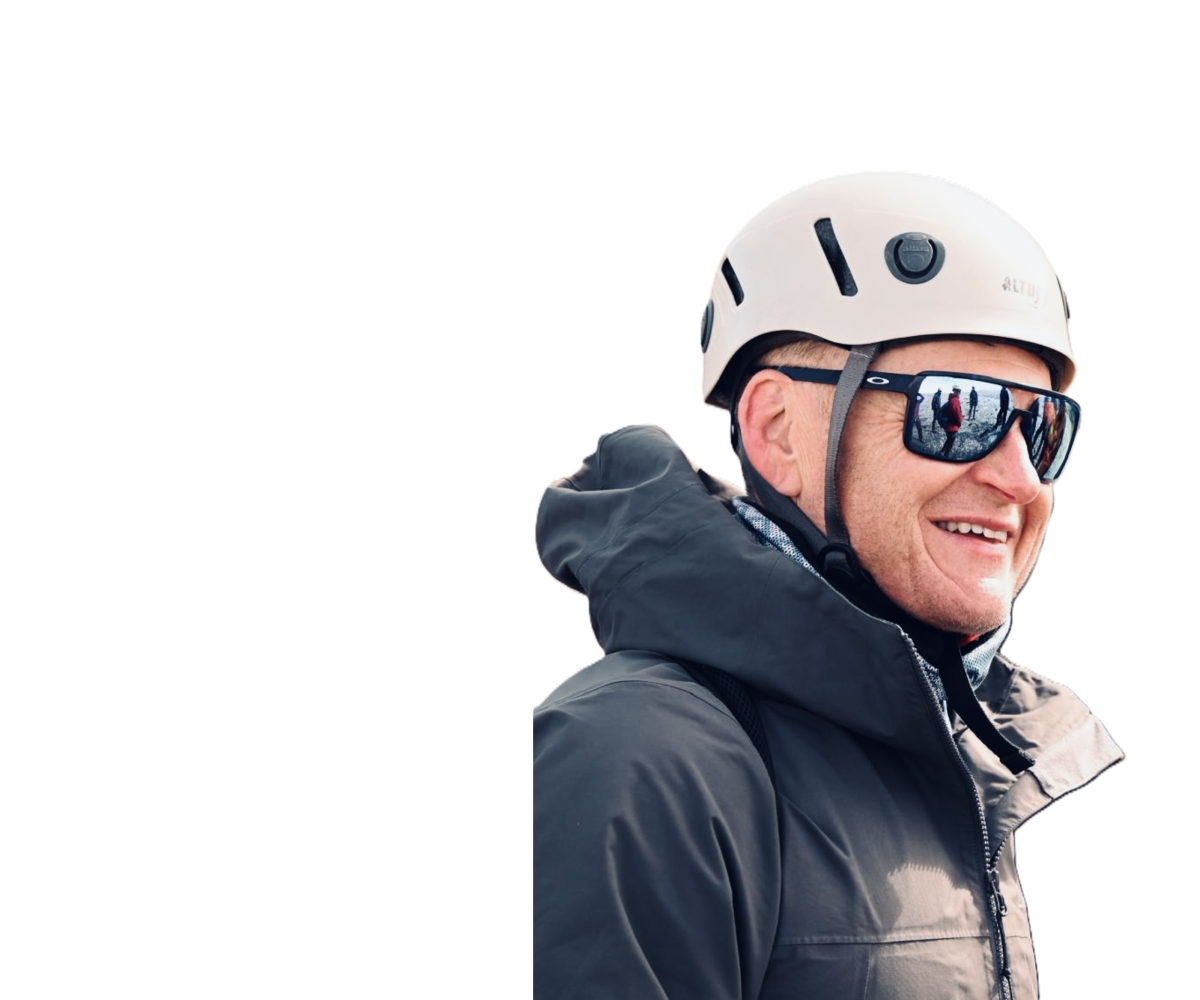
Michael began his legal career as a trainee in Clifford Chance's London office, qualifying after two years. He remained at the firm for a total of seven years, going on to build a highly successful career, holding several leadership roles across major global organisations.
After two and a half decades in law and financial services, he reached a point many professionals recognise but few act on: success, as he had defined it, was no longer enough.
“I’d always said to myself,” he explains, “if I could make it to 50, broadly intact, and with enough in the bank, I’d step away from the corporate world and do something completely different.” He did exactly that.
A career that opened doors
Michael joined Clifford Chance as a trainee in 2000, describing the offer as “one of the happiest and most exciting days” of his life. The experience proved transformative, shaping his career and setting the foundations for everything that followed.
“ It was life-changing. It set me up for everything. When you’ve got Clifford Chance on your CV, doors just open. ”
It also taught him stamina, grit and the confidence to “turn my hand to almost anything”.
Ambition, success and something more
His career after Clifford Chance followed a familiar trajectory for high performers: senior roles in global organisations, partnership at six years PQE, culminating in the C-Suite of one of the world’s largest asset managers. From the outside, it was a success story. But ambition, he now reflects, can be a double-edged sword.
Over time, personal and professional turning points - grief, hubris, burnout and reflection - forced him to confront questions many avoid: Why am I doing this? What am I working for? Is this still serving me? “The uncomfortable answer,” he admits, “was no.”
Stepping away into uncertainty
Michael had worked incredibly hard for his success.
“ People ask how I retired at 50. Mentees ask for the magic formula. There isn’t one. It just comes down to hard work, a bit of luck, and some calculated risk. As a trainee, I spent long hours doing whatever was needed; making cardboard boxes in a windowless room, proofreading, paginating. I was grateful to be at Clifford Chance, said yes to everything, and that gave me perspective. ”
Walking away from a well-established and lucrative career was not easy.
“ It wasn’t bravery, it was clarity. But it was also incredibly difficult. ”
Beyond the financial considerations, the real challenge was giving up the defining markers of identity: structure, title and the easy answer when someone asks what you do.
In the months after stepping away, there were moments of doubt.
“ It would have been easy, too easy, to go back to what you have known for so long. You just have to back yourself. Take a punt. Trust that the skills you’ve built will carry you through. They will ”
Redefining success
Today, Michael describes his role as “Adventurer”. His life now follows what he calls the “three Fs”: fun, philanthropy and finance.
That means:
- running cycling tours (through his enterprise: Ventoux Ventures or as a freelancer), endurance challenges and adventure travel (including helping others have adventures with Epic Travel);
- serving as a magistrate, mentoring and supporting community initiatives; and
- taking on selective advisory and non-executive roles, including a recent ‘adventure’ as a contractor for a private security firm across the middle east during recent hostilities.
“ If it feels like an adventure, or if I’ll learn something, or have a new experience, I’ll do it. ”
For Michael, adventure is not defined by scale, but by experience. And he now views it as part of his role now to help others experience their own adventures.
“ It doesn’t have to be climbing Everest. Adventure is not limited to physical feats; it can be any activity that pushes mental and emotional boundaries. The true value of adventure lies in the lasting impact it has on our journey toward a resilient self. Travel and adventure have a way of stripping away the veneer of control and exposing our true selves. It requires us to be vulnerable. I think leaders that show some vulnerabilities are all the stronger for it. ”
The enduring value of a Clifford Chance foundation
Despite the shift in direction, Michael is clear that his legal career, and Clifford Chance in particular, remains central to his success today.
“ The skills you learn - attention to detail, logical thinking, communication skills, navigating complex and fluid situations - are incredibly valuable outside the firm. ”
Equally important are the relationships built along the way.
“ I’m still close friends with people from my trainee cohort and the people I worked for, we went through a lot together. ”
Looking ahead
If there is one message Michael returns to, it is the importance of stepping back.
“ People don’t look up enough. They don’t stop and ask whether what they’re doing still makes sense. ”
For him, the key is not necessarily to make dramatic changes, but conscious ones.
“ Take stock. Ask yourself why you’re doing what you’re doing. There are many more possibilities out there than you think. ”
Now in what he describes as the “second chapter” of his life, success looks very different.
“ I’m healthier, more present, and more grounded. The metrics you chase in your thirties might not be the ones that matter later on. ”
For those who may at times feel trapped within a “gilded cage”, his message is simple: take a moment, look beyond the bars and consider what might be possible. Even a fleeting escape, an adventure, can change you.
If you'd like to get in touch with Michael to hear more about the life of an Adventurer, or more about his journey from the gilded cage, reach out to him on LinkedIn.


